
Home Assistant Global Health Score
HA-Pulse
On Home Assistant 2026.11 or newer? Open it in the Marketplace
- Installs
- 5.8k sharing analytics
- GitHub stars
- 470
- Connection
- Works locally
- Upkeep
- Updated in the last 6 months
- Version
- v2.3.0,
- Category
- Computers and network, Monitoring
- Kind
- Marketplace integration
- Needs
- Needs the Marketplace (HACS on 2026.10 and older)
- Domain
haghs- Issues
- Report an issue
Independent directory, made by the developer of Vulpo. Not affiliated with Home Assistant or the Open Home Foundation.
Screenshots From the README of HA-Pulse/home-assistant-global-health-score.
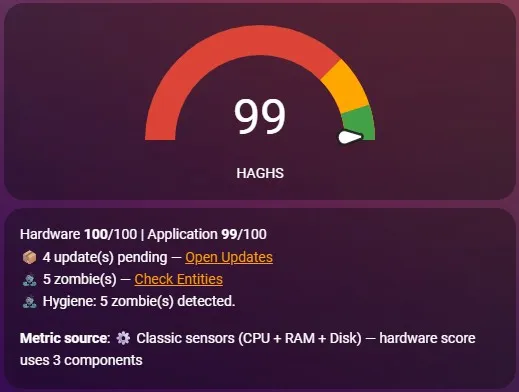
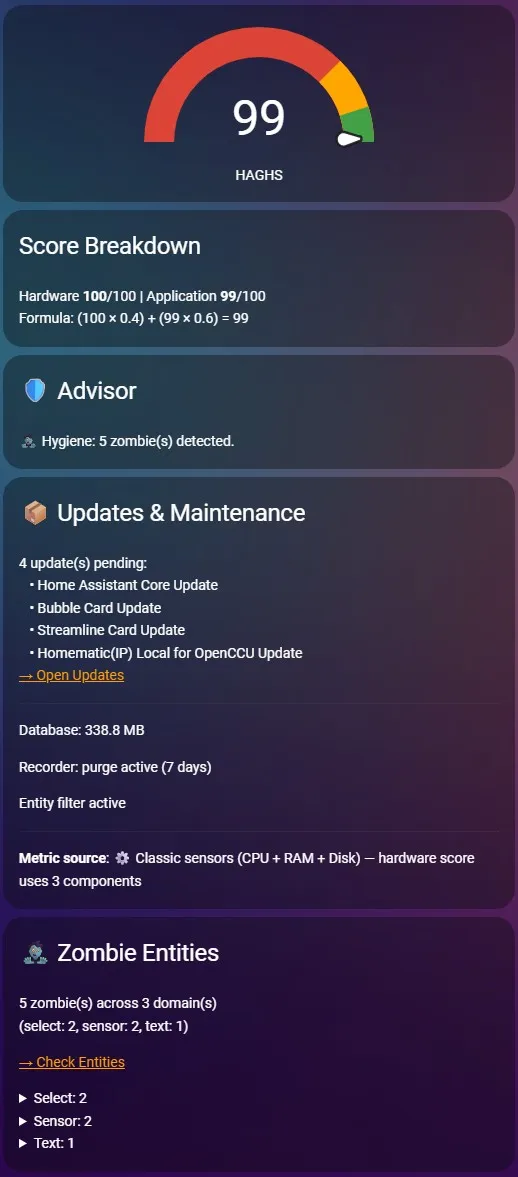
About
Home Assistant Global Health Score (HAGHS) calculates a health score from 0 to 100 for a Home Assistant instance. It runs locally and exposes the result as sensors, with the score combining a hardware part weighted at 40 percent and an application part weighted at 60 percent. Hardware load is read from Linux pressure stall data where available, and it falls back to chosen CPU and RAM sensors on systems without it. The application side looks at unavailable or unknown entities past a grace period, open repair issues, dead devices and pending updates, and it explains missing points with recommendations. Entities can be excluded through labels or entity ID patterns, and the update interval and grace periods can be adjusted in the options. It is set up in the UI and needs the Marketplace.
Automatic summary of the README and code of HA-Pulse/home-assistant-global-health-score. Something wrong, or are you the maintainer and want your own text here? Get in touch
Supports
Works locally Talks to your devices on your own network. No vendor cloud in between.
From the Marketplace Installed through the Marketplace, formerly HACS.
Actively maintained Its author released or pushed a change in the last six months.
Provides
- Sensors
Setting it up
Install it from the Marketplace and restart Home Assistant, then add it under Settings, Devices and services.
Set up Global Health Score
- CPU usage sensorSmart fallback only. HAGHS uses high-precision Linux PSI (Pressure Stall Information) values from your host system by default to calculate the score. This manual sensor is only used if your system does not provide PSI data (e.g. Windows, older Docker setups, or non-Linux hosts). If PSI becomes unavailable and no CPU/RAM fallback sensors are configured, setup will be rejected. Select the sensor that reports CPU usage in percent (e.g. 'Processor Use').
- RAM usage sensorSmart fallback only. HAGHS uses high-precision Linux PSI (Pressure Stall Information) values from your host system by default to calculate the score. This manual sensor is only used if your system does not provide PSI data (e.g. Windows, older Docker setups, or non-Linux hosts). If PSI becomes unavailable and no CPU/RAM fallback sensors are configured, setup will be rejected. Select the sensor that reports memory usage in percent (e.g. 'Memory Use Percent').
- Storage typeChoose the type of storage your HA instance runs on. SD card is the safe default for Raspberry Pi setups. SSD uses percentage-based thresholds instead of absolute free space.
- Ignore labelsSelect one or more labels from your Home Assistant labels. Entities and devices carrying any of these labels are excluded from zombie detection and update penalties. Toggle exclusions dynamically from an automation by calling Home Assistant's native 'homeassistant.add_label_to_entity' and 'homeassistant.remove_label_from_entity' service actions (e.g. switch a 'vacation' label on while you are away). Create the labels first under Settings → Labels if they do not exist yet.
- Ignore entity-id patternsOptional list of glob patterns matched against the entity_id (one per line). Entities whose id matches any pattern are excluded from zombie detection, the unregistered listing and update penalties. Use this for entities without a unique ID, which cannot carry a label (e.g. 'sensor.docker_*'). Wildcards * and ? are supported.
- Database size sensor (optional)Only needed for external databases (MariaDB, PostgreSQL). Leave empty to use the built-in SQLite auto-detection. The sensor must report database size in MB (e.g. 'sensor.mariadb_size').
After setup
- CPU usage sensorSmart fallback only. HAGHS uses high-precision Linux PSI (Pressure Stall Information) values from your host system by default to calculate the score. This manual sensor is only used if your system does not provide PSI data (e.g. Windows, older Docker setups, or non-Linux hosts). If PSI becomes unavailable and no CPU/RAM fallback sensors are configured, setup will be rejected. Select the sensor that reports CPU usage in percent (e.g. 'Processor Use').
- RAM usage sensorSmart fallback only. HAGHS uses high-precision Linux PSI (Pressure Stall Information) values from your host system by default to calculate the score. This manual sensor is only used if your system does not provide PSI data (e.g. Windows, older Docker setups, or non-Linux hosts). If PSI becomes unavailable and no CPU/RAM fallback sensors are configured, setup will be rejected. Select the sensor that reports memory usage in percent (e.g. 'Memory Use Percent').
- Storage typeChoose the type of storage your HA instance runs on. SD card is the safe default for Raspberry Pi setups. SSD uses percentage-based thresholds instead of absolute free space.
- Ignore labelsSelect one or more labels from your Home Assistant labels. Entities and devices carrying any of these labels are excluded from zombie detection and update penalties. Toggle exclusions dynamically from an automation by calling Home Assistant's native 'homeassistant.add_label_to_entity' and 'homeassistant.remove_label_from_entity' service actions (e.g. switch a 'vacation' label on while you are away). Create the labels first under Settings → Labels if they do not exist yet.
- Ignore entity-id patternsOptional list of glob patterns matched against the entity_id (one per line). Entities whose id matches any pattern are excluded from zombie detection, the unregistered listing and update penalties. Use this for entities without a unique ID, which cannot carry a label (e.g. 'sensor.docker_*'). Wildcards * and ? are supported.
- Database size sensor (optional)Only needed for external databases (MariaDB, PostgreSQL). Leave empty to use the built-in SQLite auto-detection. The sensor must report database size in MB (e.g. 'sensor.mariadb_size').
- Update intervalHow often HAGHS recalculates the health score, in seconds. Lower values mean faster updates but slightly more CPU usage. Default: 60 seconds.
- Zombie grace period (minutes)How long an entity must stay in 'unavailable' or 'unknown' before HAGHS counts it as a zombie. Allowed range: 1 to 240 minutes. Lower values make detection more aggressive (more false positives from briefly-offline devices). Higher values mask short outages but let real failures linger. Default: 5 minutes.
- Battery-class grace period (minutes)Extended grace period specifically for entities with 'device_class: battery'. Zigbee and Homematic radios routinely take longer than the regular window to re-poll battery devices, so flagging them as zombies after only 5 minutes produces false positives. Allowed range: 1 to 240 minutes. If you set this lower than the regular grace, it effectively disables the extension. Default: 60 minutes.
Texts from the code of HA-Pulse/home-assistant-global-health-score.
Troubleshooting
- Repair noticesNotices it can show in Settings, Repairs:PSI is unavailable and fallback sensors are missing
From the README
The open standard for Home Assistant instance health monitoring.
- Repairs now count in the score (#97). Open repair issues cost 5 points each (cap 10) and hard-cap the application score at 99 while any repair is open. HA's native Ignore action takes a repair out…
- Dead devices are flagged (#120). A device whose entities are all unavailable / unknown past the grace window is reported via dead_device_count, dead_devices and rec_dead_devices. Informational only,…
- Recommendation texts are translatable (#114). All recommendation templates resolve through Home Assistant's translation system (category common) in your configured language; English is the fallback.
- Unregistered entities are informational only (#98). Entities without an entity-registry entry no longer count as zombies and no longer cap the score; they are reported through the unregistered_*…
- Every missing score point is explained (#92). New attributes config_audit_bonus and integration_unhealthy_count, new flags rec_integration_health and rec_config_audit.

Shows in Vulpo
Chart card, Apple Watch.Information
- Installs
- 5.8k sharing analytics
- GitHub stars
- 470
- Connection
- Works locally
- Upkeep
- Updated in the last 6 months
- Version
- v2.3.0,
- Category
- Computers and network, Monitoring
- Kind
- Marketplace integration
- Needs
- Needs the Marketplace (HACS on 2026.10 and older)
- Domain
haghs- Issues
- Report an issue